
Accommodation in China
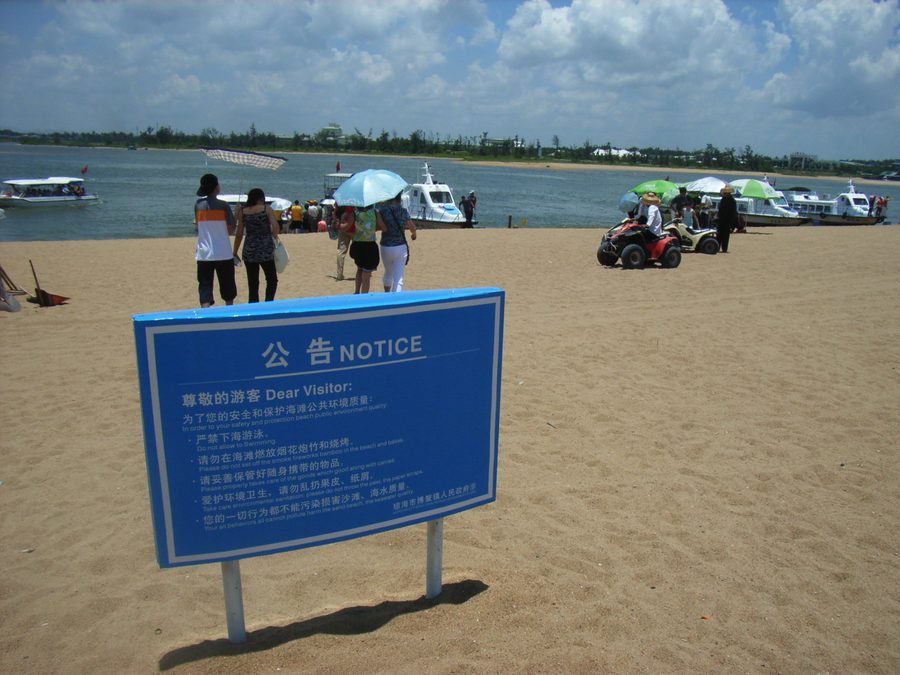 Jade Belt Beach at Boao, Hainan, provides a beach contrast to a wider China journey.
Photo: No machine-readable author provided. HNPIX~commonswiki assumed (based on copyright claims). via Source, Public domain
Jade Belt Beach at Boao, Hainan, provides a beach contrast to a wider China journey.
Photo: No machine-readable author provided. HNPIX~commonswiki assumed (based on copyright claims). via Source, Public domain
China offers families many different travel experiences: in Beijing, the Forbidden City, the Temple of Heaven, the Summer Palace, and the Great Wall stand for a journey into imperial history. Shanghai provides an urban contrast, while Yunnan combines landscapes, living traditions, and traditional craftsmanship. For those looking for a special wildlife experience, Chengdu has a strong panda association; Hainan can round off a longer trip with a tropical beach stage.
Short & sweet
- Beijing: Four famous sights — the Forbidden City, the Temple of Heaven, the Summer Palace, and the Great Wall — make the city a clear stop for culture and history.
- Shanghai: The metropolis combines Eastern and Western influences with history, art, and culture.
- Yunnan: Natural landscapes meet ethnic culture, colorful customs, and traditional craftsmanship.
- Chengdu: The city is closely associated with giant pandas, adding an unusual nature and wildlife theme to the trip.
- Xi’an: The Terracotta Warriors provide a distinct archaeological focus with thousands of life-sized handmade figures.
- Hainan: The tropical island works well as a separate beach stage after a cultural trip or tour.
- Shared experiences: Traditional kite making, cycling through landscapes, and Chinese puppet theater are mentioned as possible travel experiences.
Five very different travel ideas
China’s scale is easier to understand if you do not look for one perfect region, but instead for the kind of trip you want. Beijing suits a stay where monuments and history take center stage. Shanghai is the right counterpoint for families who want to experience a major city full of art, culture, and diverse historical influences.
Yunnan opens up a more landscape- and culture-oriented journey. Natural scenery, customs, and traditional craftsmanship offer different reasons to explore than the big cities. In Sichuan, the combination of Chengdu, a long urban history, and the panda association can become a particularly memorable theme for shared days. Shaanxi adds an archaeological focus with Xi’an and the Terracotta Warriors.
Hainan, finally, stands for a deliberate change of pace: after a sequence of cities, cultural sites, and landscape experiences, the island can serve as the tropical beach phase and the calmer part of a larger trip. This creates different travel patterns — from a focused cultural journey to a combination of discovery and relaxation.
Experiences that add variety
A China trip does not have to consist of a long list of sightseeing stops. The examples range from historic sites and museums to more active or hands-on moments. Traditional kite making, cycling through landscapes, and puppet theater can all help alternate between intense cultural days and more practical, shared activities. In each case, you should check whether the specific offer is available at your chosen destination.
The Dazu rock carvings mentioned for Chongqing and the Chongqing Natural History Museum also show how different cultural program items can be. For a family with different ages or varying energy levels, this range is valuable: one day may be shaped by a major historical theme, another by landscapes, a museum, craftsmanship, or a performance.
The regions in accommodation selection
When traveling through China, accommodation should not be thought of as one base that works for the whole country. The examples of Beijing, Shanghai, Yunnan, Sichuan, Shaanxi, and Hainan represent clearly different stages. Multiple regional stays are therefore a more sensible idea than trying to plan every experience from a single place. Exact distances and travel times depend on your specific itinerary and should be checked before booking.
For a monumental history trip, a dedicated stay in Beijing makes sense, while Shanghai can be seen as a clearly defined city break. Yunnan and Sichuan stand for other regional focuses; Hainan is intended as a separate beach phase. If self-catering and more space for shared meals matter, a holiday apartment can be appealing for a longer regional stay. For a short city stay with a packed program, central location may be the more important factor — check the exact neighborhood of the accommodation.
Regional destinations for your further selection
The direct regional selection includes Anhui, Chongqing, Fujian, Gansu, Guangdong, Guangxi, Guizhou, and Hainan. Also included are Hebei, Heilongjiang, Henan, Hubei, Hunan, Inner Mongolia, Jiangsu, and Jiangxi.
Further destinations include Jilin, Liaoning, Macau, Ningxia, Beijing, Qinghai, Shaanxi, Shandong, Shanghai, Sichuan, and Tianjin. You can also take a closer look at Tibet, Xinjiang, Yunnan, and Zhejiang as regional destinations.
Frequently asked questions about a trip to China
Which types of trip can be combined sensibly in China?
The examples given range from major cities to imperial history and archaeological culture, as well as landscapes, living traditions, and a tropical beach stage. This makes it possible to structure a trip around your own interests and the balance you want between active, cultural, and quieter days.
Which experiences complement culture and landscape days?
Alongside Beijing, Shanghai, Xi’an, Yunnan, and Chengdu, traditional kite making, cycling through landscapes, puppet theater, museums, and the Dazu rock carvings are mentioned as possible types of experience. Whether a specific offer is suitable depends on the destination.
Why can several accommodation bases make sense?
The travel examples combine very different stages: city, imperial monuments, landscapes, and beach. A separate base for each regional section can therefore fit the itinerary better than one accommodation from which all destinations are meant to be reached.

